Once the weather turns cool in Atlanta, the sniffles start going around. Kids bring colds home from school, offices fill with coughing, and holiday travel puts a lot of us in crowded airports and on MARTA trains. If you live in Doraville, Chamblee, Brookhaven or anywhere around Atlanta, it’s a good time to learn what Chinese medicine can do for cold and flu season, and what it can’t.
Dr. George Fan Xu, L.Ac., OMD, comes from a family that has practiced Chinese medicine for three generations. In our family, the first scratchy throat was never something to ignore. Here’s how Traditional Chinese Medicine (TCM) looks at colds and flu, why timing matters, and when you should see your regular doctor instead.
Have a question? Call (770) 455-8851.
How Chinese medicine looks at a cold
In TCM, a common cold is often described as an outside “pathogen” getting past the body’s surface. The surface is guarded by what TCM calls Wei Qi, sometimes translated as “defensive Qi.” When Wei Qi is strong, the idea goes, you shrug off the bug your coworker has. When you’re run down, short on sleep or chilled, it gets in more easily.
TCM also sorts colds by how they show up, because different patterns call for different care:
- Wind-Cold: chills that feel worse than the fever, body aches, a stiff neck, a runny nose with clear mucus, and no thirst. This is the classic “I got caught in the cold rain” cold.
- Wind-Heat: more fever than chills, a sore or red throat, yellow mucus, thirst and a headache.
- Damp patterns: a heavy, foggy feeling, upset stomach or loose stools along with cold symptoms.
That’s why two people with “a cold” may get very different herbs from Dr. Xu.
Why the first sniffle matters
Chinese medicine puts a lot of weight on catching a cold early, while it’s still at the surface. In practice, that means paying attention in the first day or two, when you notice the first tickle in your throat, the first chill, or that achy, “something’s coming on” feeling.
That early stretch is usually the best time to call us. In TCM thinking, once a cold has settled in deeper, with a cough that hangs on for weeks, it usually takes longer to work through.
What a cold and flu visit looks like
If you come in at the start of a cold, Dr. Xu will:
- Ask about your symptoms: chills or fever, sweating, thirst, throat, mucus color, appetite and sleep.
- Check your pulse and tongue. These help him tell a Wind-Cold pattern from a Wind-Heat pattern. If you’re new to this, our guide to your first acupuncture visit explains it step by step.
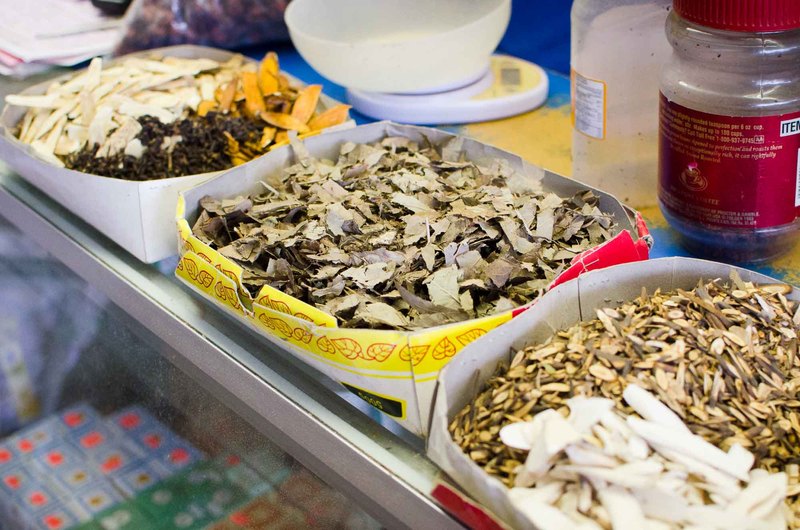
- Write an herbal formula for you. In TCM, herbs are usually the main tool for a cold. Dr. Xu measures raw herbs by hand into bags that you brew at home as tea, and the formula is short and matched to your pattern. Our post on how Chinese herbal tea works covers brewing and taste.
- Sometimes add acupuncture. A few needles can be part of the visit, depending on how you feel. If you’re nervous about that, read what acupuncture needles really feel like.
The goal is to support your body while it does its work, help you feel more comfortable, and get you back on your feet. Chinese medicine is not a replacement for a flu shot, flu testing, or medicine your doctor prescribes.
Simple habits Chinese medicine recommends
Our family’s advice for cold and flu season is mostly common sense, and much of it lines up with what your doctor would say:
- Keep your neck and back covered. TCM sees the back of the neck as a place where wind and cold get in. A scarf on a chilly morning at the MARTA station is old wisdom.
- Rest early. Going to bed when you first feel off is better than pushing through.
- Eat warm, simple food. Soups, congee and cooked vegetables are easier on digestion than cold or greasy food when you’re sick.
- Warm drinks. Many families brew a simple ginger and scallion tea at the first chill. It’s a kitchen tradition, not a prescription, so check with Dr. Xu before using it if you take medication or have a health condition.
- Wash your hands and stay home when you’re sick. No herb replaces that.
If your nose stays stuffy long after the cold is gone, it may be allergies or sinus trouble instead. Read our post on acupuncture for allergies and sinus trouble.
When to see your doctor or urgent care instead
Please don’t wait on Chinese medicine if you have any of these. See your doctor, go to urgent care, or call 911:
- Trouble breathing, shortness of breath or chest pain
- A high fever, or a fever that lasts more than a few days
- Confusion, a severe headache with a stiff neck, or fainting
- Signs of dehydration, such as very little urine
- Symptoms that get better and then suddenly get worse
- A sick infant, or any concern if you’re pregnant, over 65, or have asthma, diabetes, heart disease or a weakened immune system
Flu can be serious, and your doctor can test for it and, in some cases, prescribe antiviral medicine that works best when started early.
FAQ
Can Chinese medicine cure a cold or the flu?
No treatment cures the common cold, and we don’t promise that herbs will. Chinese medicine aims to support your body and ease symptoms based on your pattern. Many patients like having it as part of their care, alongside their doctor’s advice.
Should I still get a flu shot?
That’s a question for your doctor, and we encourage you to follow their advice. Chinese medicine is meant to work alongside regular medical care, not replace it.
Can I take Chinese herbs with cold medicine?
Sometimes, but tell Dr. Xu about every medicine and supplement you take, including over-the-counter cold and flu products. Some don’t mix well with certain herbs.
Are cold and flu herbs safe for children?
Children need different care and doses. Call us first, and always involve your child’s pediatrician.
Where is your clinic?
We’re at 6021 New Peachtree Rd. in Doraville, right across from the Doraville MARTA station, a short drive from Chamblee, Buford Highway and the rest of the Atlanta area. See directions and hours.
Book a visit at the first sign of a cold
If you feel a cold coming on, or you’d like help getting through cold and flu season, we’d be glad to see you. Learn more about Dr. Xu and our treatments, or visit our homepage.
Call Shallowford Herbs & Acupuncture Clinic at (770) 455-8851 to book your visit.
This article is for general education only and is not medical advice. Acupuncture and Chinese herbal medicine are not a substitute for diagnosis or treatment by your physician. Results vary from person to person. If you have a medical emergency, call 911.