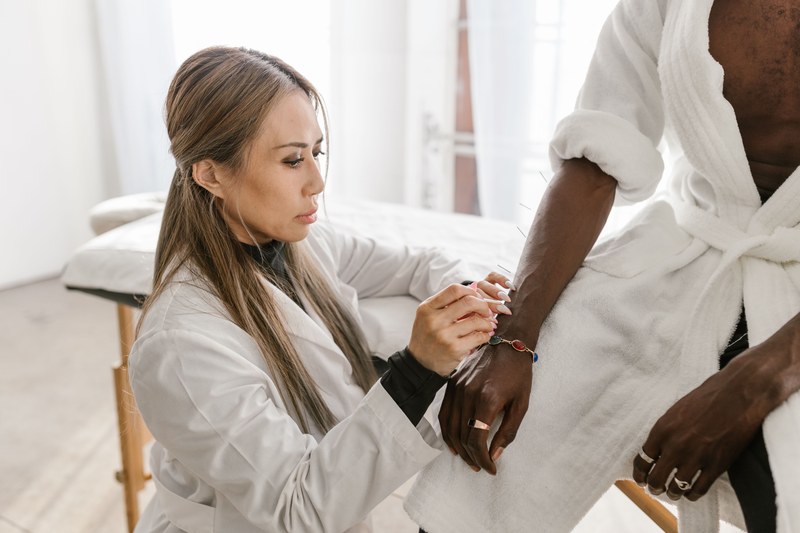
Usually, no. Most people feel very little when acupuncture needles go in, and many don’t feel them at all. You might notice a quick pinch, then a dull, heavy or tingling feeling at the point. Any sharp feeling should fade within seconds, and if it doesn’t, the needle can be adjusted or removed. Most patients are surprised by how relaxed they feel.
“Does it hurt?” is the question we hear most from first-time patients at our clinic across from the Doraville MARTA station. It’s a fair question. Most of us connect needles with shots and blood draws. Here’s an honest answer, including the sensations you might feel and what you can do to stay comfortable.
Nervous about your first visit? Call (770) 455-8851 and ask us anything.
Why acupuncture feels nothing like a shot
The needles are the big difference.
- They’re very thin. Acupuncture needles are much thinner than the needles used for shots or blood draws, according to Cleveland Clinic.
- They’re solid, not hollow. A shot needle is a hollow tube built to push medicine in or draw blood out. An acupuncture needle is a fine, solid wire with nothing going in or out.
- They’re sterile and single-use. The U.S. Food and Drug Administration regulates acupuncture needles as medical devices and requires them to be sterile and labeled for single use, as NCCIH explains.
Cleveland Clinic says the small prick of an acupuncture needle is less painful than getting a vaccine or having blood drawn. Mayo Clinic says insertion usually causes little discomfort and people often don’t feel the needles go in at all.
What acupuncture actually feels like
Here’s what you might notice during a session.
When the needle goes in
Often nothing. Sometimes a light tap or a brief pinch. In an article on what acupuncture really feels like, Cleveland Clinic explains that because most needles feel like nothing, the one you do feel can catch you by surprise. That pinch usually fades in a few seconds.
Once the needle is in place
You may feel a dull ache, heaviness, warmth or a mild tingling around the point. Mayo Clinic describes a mild aching feeling when a needle reaches the right depth. In Chinese medicine this sensation has a name, de qi (pronounced “duh chee”), as the British Acupuncture Council explains. These sensations do not by themselves show whether treatment will help your symptoms. It should feel deep and dull, not sharp.
While you rest
Many people feel calm, even sleepy. The UK’s University College London Hospitals describes the feeling around the needle as warm and heavy, and “usually quite pleasant.”
When the needles come out
Mayo Clinic notes that there’s usually no discomfort when needles are removed.
Why some spots feel more than others
Not every point feels the same. Cleveland Clinic notes that some areas tend to be more sensitive:
- Fingers, toes and ears, which have more nerve endings
- Muscles, where you may feel heaviness or a twitch
- Sore or inflamed areas, such as a recent injury
- Small blood vessels, which can leave a drop of blood or two
If you’re dealing with pain somewhere, tell Dr. Xu before he starts.
What to expect afterward
Most people feel relaxed, and some feel energized. Common, minor side effects include:
- Soreness where a needle was placed
- Minor bleeding or a small bruise
- Feeling tired or a bit drowsy for a while
Mayo Clinic lists soreness and minor bleeding or bruising as the common side effects. University College London Hospitals lists short-lived drowsiness as common too. Cleveland Clinic suggests resting for 5 to 10 minutes before you drive, especially after your first visit, since acupuncture can be calming. Serious complications are rare when acupuncture is done by a trained practitioner with sterile needles, according to NCCIH.
How to make your first session more comfortable
- Eat a light meal beforehand. University College London Hospitals notes that fainting is rare but can happen, particularly at a first treatment. The British Acupuncture Council asks patients to say if they’re hungry or thirsty.
- Wear loose clothes so your arms and legs are easy to reach.
- Say you’re nervous. Dr. Xu can explain each step before he does it.
- Breathe slowly as each needle goes in.
- Speak up. If a needle pinches or aches more than you like, tell him. It can be adjusted or removed.
Who should check first
Before acupuncture, tell Dr. Xu if you:
- Are pregnant or nursing
- Have a pacemaker
- Take blood thinners or have a bleeding disorder
Mayo Clinic points out that some acupuncture points are thought to stimulate labor, and that electrical stimulation on needles could interfere with a pacemaker. And as NCCIH reminds people, don’t use acupuncture to put off seeing a doctor about a health problem.
About our clinic
Dr. George Fan Xu, L.Ac., OMD, is NCCAOM certified in acupuncture and Chinese herbology. He comes from three generations of TCM practitioners and has cared for Atlanta-area patients for decades. Our FAQ notes that we use very thin, sterile needles, and most patients feel minimal sensation.
Want to know what else happens at a first visit, from pulse reading to your herbal tea? Read our guide to your first acupuncture visit. Curious about what people come in for? See how acupuncture fits back pain or allergies and sinus trouble.
FAQ
Does acupuncture hurt the first time?
Most first-timers feel less than they expect. The first session may feel more noticeable simply because everything is new. Tell Dr. Xu if you’re nervous, and he’ll walk you through it.
How thin are acupuncture needles?
Much thinner than the needles used for shots or blood draws. They’re solid, not hollow, which is a big reason they feel so different.
Is it normal to feel a dull ache?
Yes. A dull ache, heaviness or tingling at the point is common, and Mayo Clinic describes a mild aching feeling when a needle reaches the right depth. A sharp or burning pain that doesn’t fade isn’t something to put up with. Tell Dr. Xu.
Will I bleed or bruise?
Sometimes you’ll see a tiny drop of blood or a small bruise. Both are common and minor.
Can I drive home afterward?
Most people can. Cleveland Clinic suggests resting for 5 to 10 minutes first, especially after your first visit.
What if I’m afraid of needles?
You’re not alone, and it’s fine to say so. Dr. Xu can explain each step and go at your pace.
Book your first visit
If worry about needles is the only thing holding you back, come talk with us. We’ll explain everything before we start, and you can ask to stop at any time.
Call Shallowford Herbs & Acupuncture Clinic at (770) 455-8851 to book your visit, or see directions and hours.
This article is for general education only and is not medical advice. Acupuncture and Chinese herbal medicine are not a substitute for diagnosis or treatment by your physician. Results vary from person to person. If you have a medical emergency, call 911.